

A Well Oiled Machine
Turn the clock back to a time when audio effects were still uncharted territory, and experience the vintage syrupy warble of a true oil can echo.
From dark and modulated repeats to sustaining textures that approach the sound of classic spring reverb tanks, Olivera is the first pedal emulation that truly captures the mechanical yet wildly organic nature of these oddball machines, bringing funky inspiration to anything you run through it.
Different By Design
The first oil can echoes were made by the Tel-Rey company in 1959, achieving the repeats by writing a static charge to a small rotating disk inside a can, using oil as a lubricating dielectric. This novel approach yields very different sounds than what you would hear from a tape machine, and the results instantly transport the listener to a darker and murkier place that positively oozes vibe.
The sheer number of variables in the design made authentic emulation challenging, requiring a ton of research and a brand new algorithm to get to the realism that we set out to achieve. We feel confident that Olivera captures the true soul of the original units, from the dark repeats with unique rhythmic and decay characteristics to the unreal thick modulation that changes and morphs as the audio does. No other type of delay can do what an oil can does, and no other pedal emulation comes close to Olivera.
Vintage Stereo Echo Enhanced With Modern Features
Olivera has a host of powerful features that make it easy to integrate these nostalgic sounds into your modern rig: Discrete stereo operation for independent processing of the left and right stereo inputs. A simplified control set and expression pedal and Multiswitch capability. Delay spillover for preserving repeats when the pedal is switched off. Discrete Class A JFET stereo input preamp for exceptional touch sensitivity and ideal frequency response. MIDI control of patch recall and continuous controller data. Premium components, rugged construction that can take a beating and a USB jack for performing firmware updates or controlling the pedal from your computer.
Olivera makes it easy.
How An Oil Can Echo Works
Vintage oil can echo devices are electromechanical units that write a static charge onto a rotating disk housed in a can partially filled with oil. The oil serves as a lubricant that helps retain the charge on the disk. The resultant delay signal is very band limited, creating a murky sounding echo. But that’s not the only quality that gives the oil can echo its atmospheric magic.
The units have a record head and typically two playback heads, but generally no erase head, allowing some dissipating charge to remain as the can rotates. This contributes to two unique characteristics of these systems.
First, it creates a regenerating repeat even when no feedback (REGEN) is applied from the playback heads. The static charge has its own decay time constant, so there are always “repeats” from the echo at all settings.
Second, it creates an uneven cadence to the echoes, where the first echo occurs based on the distance from the record head to the playback head. But subsequent echoes occur at the rotational speed of the system as the dissipating signal comes back around on the disk. The resultant off-kilter delay cadence is largely responsible for creating the sense of atmosphere without a strong “rhythmic” element.
By adding feedback (REGEN) from the playback heads, and/or combining the output of the two heads, the atmospheric nature of the echoes increases.
Sound Design
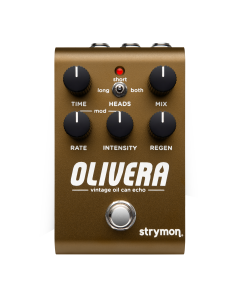
Time
The Time knob determines the delay time for the repeats by adjusting the rotational speed of the oil can. Some vintage units had a fixed speed, but we’ve allowed the rotational speed to vary between roughly 200ms to 800ms in total delay time, which can be further modified by the Head selection switch.
Short Head delay time: 72ms – 290ms
Long Head delay time: 155ms – 620ms
Disc Rotation, 200ms – 800ms (residual static repeats)
Heads Control
Vintage oil can echo units had a single record head and two playback heads. The playback head’s distance from the record head determined the decay time of the echo, and you can choose from ‘Short’, ‘Long’ or ‘Both’ with this switch. The ‘Short’ setting selects the head that is the closest to the Record head for the shortest echo, and the ‘Long’ setting selects the head that is the farthest away from the Record Head for the longest echo. The ‘Both’ setting enables both heads at the same time, giving the repeats a lopsided and complex scenario.
Mix
This control determines the mix of the wet and dry signal, with a 50/50 mix of wet and dry occurring at roughly 3 o’clock on the knob.
Rate
Controls the speed of the modulation.
Intensity
Controls the intensity of the modulation, where the modulation becomes much more prominent in the audio mix the higher the position of the knob.
Regeneration
This control was often labeled “reverb” on vintage units, and it controls the amount of echo repeats that are fed back into the can to be reprocessed.
Higher settings of the knob create a reverberant and atmospheric character, which many would say is one of the signature elements to the sonic character of an oil can echo.
NOTE: Hold the footswitch while turning the Regeneration knob to adjust the tone of the repeats. Noon on the knob is the character that we captured from our reference units, with lower settings being darker, and higher settings brightening the repeats.
Infinite Mode
Use a Strymon MiniSwitch to engage continuous repeats — just like turning the Regeneration knob to maximum — for endless, evolving echoes.
MIDI
Limitless Possibilities.
True/Buffered Bypass
Choose Your Bypass Mode.
JFET Input
Analog Touch.
Stereo
Moving In Stereo.
ARM Processor
Power To The Pedal.
MultiSwitch Plus
Switch Things Up A Bit.
Ins, Outs, and Switches
Audio Quality
More
Dimensions:
| SKU | STY-Z120OLIV-B |
|---|---|
| Brand | Strymon |
| Weight | 0.700000 |
| Refund period | 35 days |
|---|






Login and Registration Form